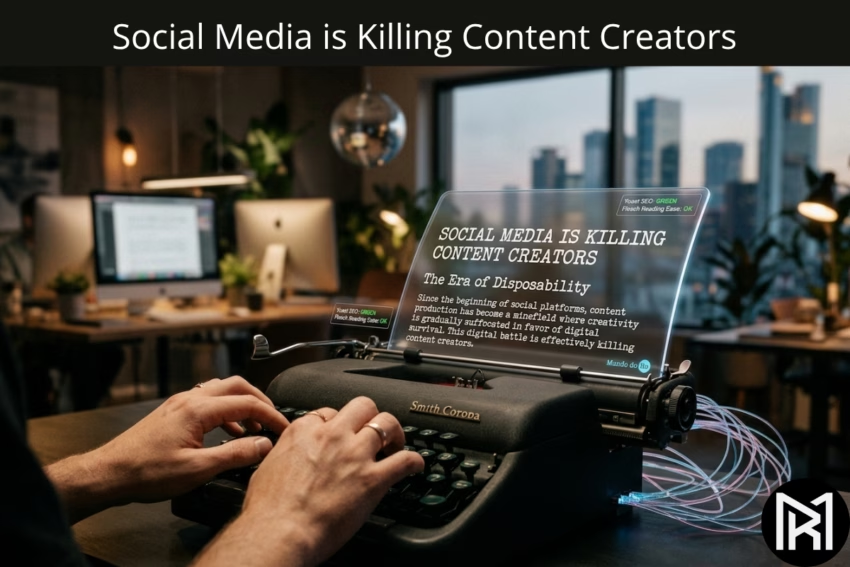
Though the title may seem contradictory at first, it reflects a very somber reality. Since the beginning of social platforms, content production has become a minefield where creativity is gradually suffocated in favor of digital survival. This digital battle is effectively killing content creators.
When I began my journey online, around 2012, the ecosystem was ruled by blogs and, to a lesser extent, YouTube. Back then, value lay in detail and context. We produced dense texts or videos that easily exceeded ten minutes because the audience sought depth. We admired bloggers and vloggers for their ability to sustain a line of reasoning, and it was this desire to share worldviews that motivated me to enter the field.
The Era of Disposability
With the rise of Instagram and the turn of the decade, the axis shifted toward the aesthetic of the image. Even though long captions persisted, the focus had already moved to the visual. Simultaneously, YouTube videos grew in length, consolidating the era of detailed experiences and authorial opinions. We wanted to know more, follow daily lives, and dive into experiences much like the fanfics that defined that generation.
However, after 2020, the landscape underwent an aggressive mutation. The arrival of TikTok imposed the dictatorship of immediacy. Public interest migrated to the quick and the entertaining, prioritizing dances and sketches. Currently, for content to be delivered, it must be a hyper-edited video with specific filters and soundtracks. The simplicity of a direct recording has lost ground to frenetic post-production and a culture of disposability.
Focus has shifted from the text to the headline, where only the first three lines or the initial five seconds determine a work’s relevance, even if its shelf life doesn’t exceed 24 hours.
In this environment, communication has been forced into an almost infantile codification. To speak of “death” is to sentence a video to algorithmic limbo, forcing us to use terms like “unalive.” Serious subjects such as assault or suicide are unpronounceable under the risk of losing one’s account. Even educational topics on sexuality face severe restrictions, categorized as inappropriate. This “sanitization” of vocabulary wounds journalistic precision and limits the reach of essential discussions.
Not to mention the passivity of those who consume. There is an abyssal difference between hearing and listening. Today, the audience hears the noise but doesn’t listen to what is actually being said. It is an “autopilot” mode where information passes through without being processed. Consumption has become purely auditory and visual, devoid of critical understanding.
Everything is not what it seems
To make matters worse, we are living through the collapse of the notion of reality. In an era dominated by AI-generated news and content, we have lost the ability to distinguish fact from simulacrum. As Selena Gomez once said, “everything is not what it seems,” and never has that phrase been more literal. The border between the real and the artificial has vanished, leaving both the public and creators in a state of permanent disorientation.
The killing content creators happens precisely at this crossroads of isolated niches and punitive algorithms. If you replicate common sense, you are rewarded. If you seek authenticity, you end up ignored for not belonging to the mainstream. As a journalist by trade and a creator by passion, I feel like a hostage to metrics just to share my work and my vision of the world.