
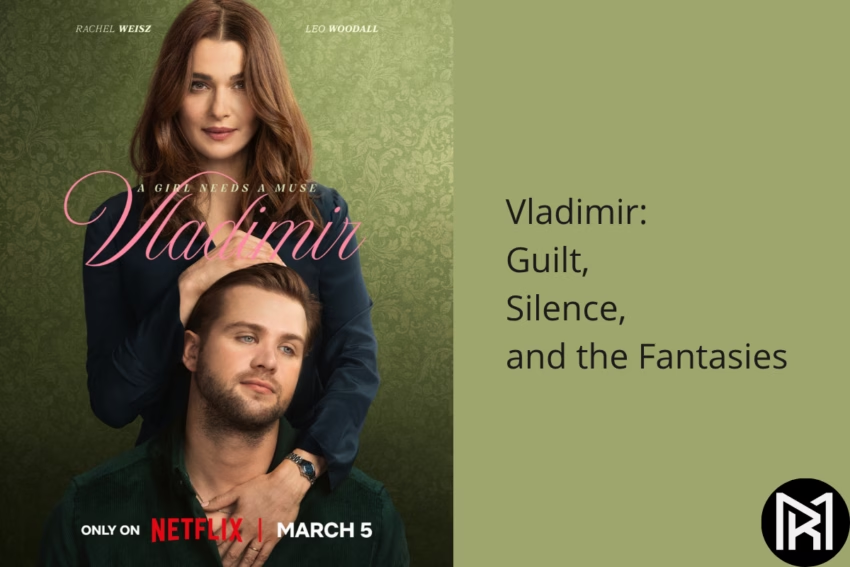
The more I think about Vladimir, the less I see it as a story about obsession. To me, it’s actually about guilt.
The protagonist doesn’t start fantasizing simply because she’s charmed by someone younger. She starts because she’s suffocating. There is a weight inside her that just doesn’t fit anymore. Her husband was accused of having affairs with students, and that’s not a small mistake or a minor slip. It’s the kind of thing that destroys reputations, careers, and above all, relationships. What strikes me most is that she doesn’t scream, she doesn’t confront him, and she doesn’t leave. She stays.
But staying is a choice that comes with a heavy price.
Her silence isn’t neutral; it’s corrosive. It turns her into an accomplice in the eyes of others and, even worse, in her own eyes. There’s a profound shame there and a sense of failure. It’s as if admitting the marriage is over would mean admitting that all the years she dedicated to it were a mistake. That might be the sharpest pain of all.
The High Price of Self-Sacrifice
She gave up so much to sustain that relationship. When it all starts to crumble, she realizes she sacrificed parts of herself for someone who didn’t do the same for her. This doesn’t just create sadness. It creates resentment, humiliation, and a strange kind of guilt for letting things get to this point.
When guilt becomes too much to handle, the mind looks for an escape. That is where Vladimir comes in.
But he doesn’t appear as an overwhelming passion. He emerges as a possibility. He is a mirror reflecting a version of her that might never have existed, but one she wishes had. When they share academic interests and talk about literature, she begins to see a parallel life. A reality where she made different choices, where she was stronger, and where she didn’t remain silent.
Vladimir: A Mirror, Not a Passion
She isn’t in love with him. She’s in love with the idea of who she could have been.
As reality tightens its grip, the fantasy grows more intense. She exaggerates signs and reacts disproportionately, not because she’s reckless, but because she’s desperate to feel something other than shame and frustration. Silence is the trigger for everything. Silence toward her husband, toward the university, and toward her own disappointments.
When you swallow your words for too long, they start to come out in other ways. Sometimes as a fantasy. Sometimes as an obsession.
What touches me about this series is exactly that. It’s not about forbidden desire. It’s about a woman who realizes too late that she abandoned herself over the years. By the time she finally sees herself, she is filled with resentment and regret, with no idea how to rebuild her own identity.
Running Away vs. Facing the Truth
Maybe Vladimir is uncomfortable because it shows something nobody likes to admit: running away is easier than confronting the truth. Imagining an alternative life hurts less than admitting the real one needs to change.
In the end, the question isn’t about her. It’s about us. How many times have we stayed silent just to avoid a confrontation? How many times have we held onto something that was already over? And how many fantasies have we built just to avoid saying what actually needs to be said?